Owner economics
What it really costs to operate a helicopter in Nigeria
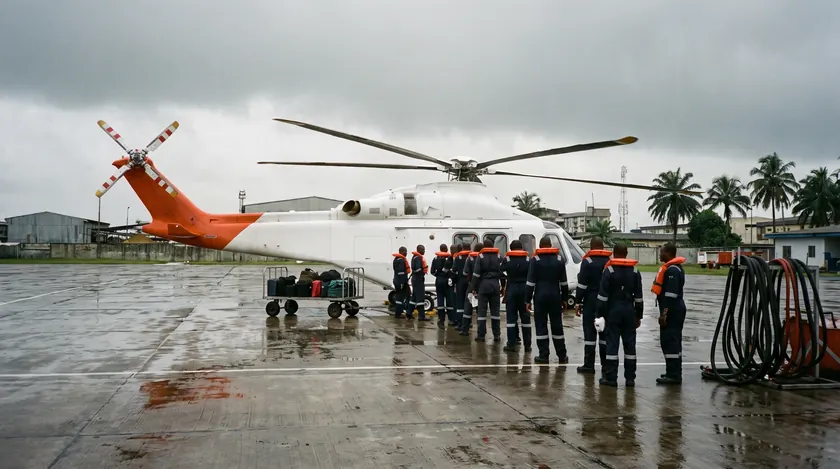
We get asked this on almost every first call from a Nigerian owner or a flight department building next year's budget: what does an hour in the air actually cost, once fuel, the maintenance reserve, crew and what customs takes at the border are all added up. The honest answer depends on the airframe, but the shape of the number is consistent enough to plan against.
This guide walks through direct operating cost by type, what changed at the border from January 2026, and the real breakeven between owning and chartering. Figures below come from current pre-owned listings and published operator cost models where a citation exists. Where the market has no single agreed number, we say so and give a working range rather than invent one.
How much does it cost to run a helicopter per hour
Direct operating cost (DOC) is fuel plus the maintenance reserve you set aside per flight hour for scheduled inspections, overhauls and consumables. It rises with engine count and cabin class, and it is the number to use for a like-for-like comparison between types, before hangarage, insurance and crew are added.
The table below cites a published operator cost model where one exists, most notably the Leonardo AW139, which is the dominant offshore type in Nigerian waters and has an actual owner-operated figure attached to it. Everywhere else, we mark the number as an estimate built from fuel burn and reserve conventions for that class, and you should confirm it against your own utilization before committing it to a budget.
| Model | Category | Hourly DOC (USD) | Basis |
|---|---|---|---|
| Robinson R44 Raven II | Light single piston | $300-500 | Cited: fuel plus maintenance reserve |
| Bell 206 JetRanger/LongRanger | Light single turbine (legacy) | $450-650 | Estimate: rises with airframe age |
| Robinson R66 | Light single turbine | $450-600 | Estimate: turbine step-up from R44 |
| Bell 505 | Light single turbine | $500-700 | Estimate: entry-level turbine class |
| MD 500E | Light single turbine | $600-850 | Estimate: utility class |
| Bell 407GXi | Light single turbine | $550-900 | Estimate: wide spread by utilization |
| Airbus H125 | Light single turbine | $700-900 | Estimate: fuel plus maintenance reserve |
| Airbus H130 | Light single turbine, wide cabin | $750-950 | Estimate: shares dynamics with H125 |
| Leonardo AW109 | Light twin turbine | $1,800-2,500 | Estimate: light-twin VIP or utility class |
| Bell 429 | Light twin turbine | $1,800-2,200 | Estimate: twin premium over single class |
| Sikorsky S-76 | Medium twin turbine | $2,800-3,500 | Estimate: varies hugely by variant |
| Airbus H145 | Light twin turbine | $3,400-4,400 | Cited: at approx. 100 hrs/year utilization |
| Leonardo AW139 | Medium twin turbine | approx. $5,339 | Cited: at 300 hrs/year, owner-operated, $9/gal fuel |
Fixed costs before the rotors turn
Hangarage, insurance, recurrent training and a retained crew all sit above the hourly DOC line, and none of them care how many hours you actually flew this year. Insurance and hangarage are quotable in a day from a local broker or the FBO you are based at, so we will not guess a figure here.
Pilot cost is the one owners most often get wrong, because it varies enormously by type rating and by whether you hire an expatriate captain or a Nigerian-licensed pilot already current on your airframe. A single-engine VFR pilot costs meaningfully less than a twin-engine, IFR-current captain qualified on an AW139 or an H145. Rather than quote a placeholder number that will be wrong for your case, ask an operator that actually employs captains in Nigeria, such as Bristow Helicopters Nigeria or Caverton Helicopters, or a local aviation recruiter, for a current figure before you commit it to a budget.
Owning versus chartering: the real breakeven
The AW139 numbers above make the logic visible: an owner flying 300 hours a year is looking at roughly $5,339 an hour in direct cost, while the same aircraft class is chartered in the market at around $1,250 an hour. That gap looks strange until you remember the charter rate is built on an operator's pooled utilization across many owners' hours, spreading fixed costs (crew, hangarage, standing maintenance contracts) across a far larger annual total than most private owners ever fly.
The way to work out your own breakeven is mechanical, not emotional.
- Add up your realistic annual hours, not your aspirational ones.
- Multiply by the direct operating cost for your target type from the table above.
- Add fixed costs: insurance, hangarage, a retained crew, recurrent training.
- Compare that total to the same hours purchased as charter from an operator like Bristow or Caverton.
- If the two numbers land close together, own only if scheduling control is worth paying for, not because ownership feels like the serious option.
Prefer to just ask? Send a short message, we reply the same day.
Ask a questionWhat is the import duty on a helicopter in Nigeria
The number changed materially at the start of this year. From 1 January 2026 the Nigeria Tax Act 2025 reimposed customs duty on imported aircraft and parts, ending the blanket exemption that previously covered commercial-airline imports, with rates now running 5 to 35 percent depending on the HS code the airframe is classified under. A 7.5 percent VAT was reinstated on imported aircraft, parts and domestic tickets at the same time, reversing the airline VAT exemption that had applied for years. ECOWAS Trade Liberalization Scheme and Comprehensive Import Supervision Scheme charges apply on top of duty and VAT even where an exemption otherwise exists.
We cover the full registration and landed-cost walkthrough, including how NCAA classification affects which rate applies, in our Nigeria import guide. The short version for a budget: a private import that used to clear close to duty-free now carries a real bill, and it belongs in your acquisition math, not as an afterthought once the aircraft has already landed.
Maintenance: the annual number owners underestimate
There is no honest flat annual figure for maintenance, because it depends entirely on hours flown and where the airframe sits in its overhaul cycle. A Robinson on its 12-year or 2,200-hour overhaul clock and a turbine approaching a hot-section inspection both generate a lump-sum year that a simple hourly reserve will not fully cover, so budget the DOC figure as a floor and plan for a larger cash call in the year a major component comes due.
Bristow Helicopters Nigeria and Caverton Helicopters both run in-house maintenance capability, Bristow through an NCAA-approved training organisation and Caverton through its own rotary and fixed-wing MRO plus an EASA-certified training facility in Lagos. If you are an independent owner without that captive capability, the practical route is the one most private Nigerian owners already use: routing heavier checks through South African facilities such as NAC at Rand Airport or Hover Dynamics at Grand Central, given the limited third-party rotorcraft MRO capacity in-country. Our Nigeria maintenance page has the local contacts.
What helicopter is cheapest to operate
Of the types we place across the continent, the Robinson R44 Raven II is the cheapest to fly at $300-500 an hour direct cost, which is a large part of why AvBuyer counts more than 300 of them working in Africa, mostly in South Africa's private-owner, farm-management and training fleets. It is a piston helicopter with a strict 2,200-hour or 12-year overhaul and less margin at altitude than a turbine, so cheap to run is not the same question as right for your mission. If your work needs turbine reliability or better hot-and-high performance, we lay out that trade in our R44 versus R66 comparison guide.
Frequently asked questions
How much does it cost to run a helicopter per hour?
Direct operating cost runs from about $300-500 an hour for a Robinson R44 up to several thousand dollars for a medium twin like the AW139, which is cited at roughly $5,339 an hour at 300 owner-operated hours a year. Engine count and cabin class explain most of the spread, and fuel plus the maintenance reserve are the two components driving the number.
How much does a helicopter pilot cost in Nigeria?
It varies too widely by type rating and experience to quote a single figure honestly. A single-engine VFR pilot costs meaningfully less than a twin-engine, IFR-current captain qualified on an AW139 or H145. Ask an operator that employs captains locally, such as Bristow Helicopters Nigeria or Caverton Helicopters, or a Nigerian aviation recruiter, for a current number.
Is it cheaper to own or charter a helicopter in Nigeria?
It depends on your realistic annual hours. Charter rates are built on an operator's pooled utilization across many owners, so they can beat a single owner's direct cost at low personal usage. Add your fixed costs (insurance, hangarage, crew, training) to your direct operating cost total and compare it to the same hours bought as charter before deciding.
What is the import duty on a helicopter in Nigeria?
From 1 January 2026 the Nigeria Tax Act 2025 reimposed customs duty of 5 to 35 percent by HS code on imported aircraft, plus a reinstated 7.5 percent VAT, ending the prior blanket exemption for commercial-airline imports. ECOWAS Trade Liberalization Scheme and Comprehensive Import Supervision Scheme charges apply on top. Confirm classification with NCAA and a licensed customs broker before you land an airframe.
What helicopter is cheapest to operate?
Among the types we track, the Robinson R44 Raven II is cheapest to fly at $300-500 an hour direct cost, and it is Africa's most numerous piston helicopter for exactly that reason. It trades altitude margin and turbine reliability for that low running cost, so match it to a mission that does not need either.
Want a number checked against current Nigerian operator data
Send us the type and your realistic annual hours and we will sanity-check the budget before you commit to it.
Ask a question