Maintenance & MRO · Angola
Helicopter Maintenance in Angola
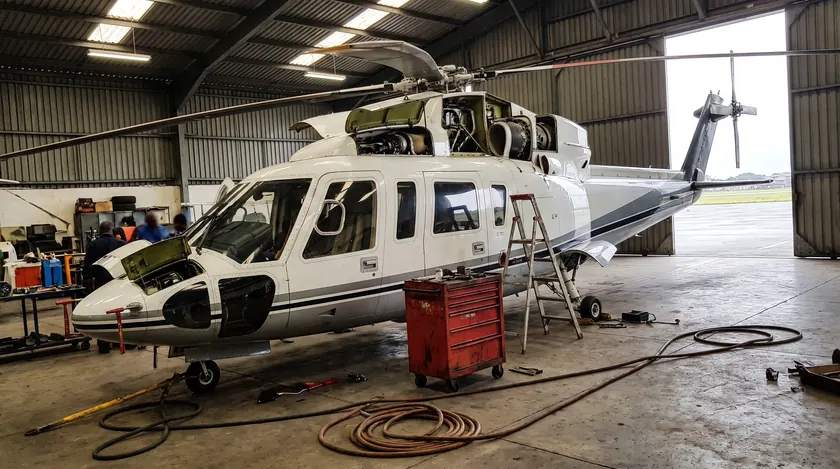
Angola's helicopters mostly work for oil companies, and so does most of the country's maintenance capacity. Heli Malongo Airways and SonAir maintain their own offshore fleets under INAVIC-approved manuals, and a private or corporate owner outside that world has a narrower set of options.
This page covers what a D2- registered helicopter can get done inside Angola, what the CIF-based duty and VAT bill looks like on parts, and where heavier work actually goes.
Who maintains helicopters in Angola, and who does not take outside work
Heli Malongo Airways flies Bell 412 and 427 crew-change and logistics work for the Cabinda oil industry, including ChevronTexaco and Cabinda Gulf Oil operations, out of Cabinda Airport (CAB/FNCA), the gateway to the Malongo offshore enclave. Its Maintenance Control and Maintenance Procedure Manuals are INAVIC-approved and manufacturer-aligned, which keeps its own fleet compliant but does not make it a third-party shop for an outside owner's aircraft.
SonAir flies a Sikorsky S-76C fleet, formerly also Super Puma EC225s until they were grounded in 2016 over safety concerns, on similar crew-change and logistics contracts. Bestfly and Westair Helicopters are also active in the market, again largely on their own contracted fleets rather than as open MRO providers.
Tecnair Maintenance is the name that does provide general-aviation MRO in-country for outside customers. Beyond Tecnair, owners of lighter or private helicopters typically route heavier maintenance through South African AMOs given limited local rotorcraft-specific capacity. See the wider picture at helicopters in Angola.
Scheduled checks, overhauls, parts and avionics: the realistic split
The offshore majors maintain their own aircraft under their own manuals. This is the picture for everyone else.
| Service | In Angola | Notes |
|---|---|---|
| Scheduled inspections | Partial, via Tecnair Maintenance | Covers general-aviation work; offshore majors maintain their own fleets separately |
| Component/engine overhaul | Usually abroad | Typically routed to a South African AMO given limited rotorcraft-specific capacity in-country |
| AOG parts sourcing | Limited | Most parts for private or corporate aircraft are airfreighted in, CIF duty and VAT included in the timeline |
| Avionics work | Limited | Specialised avionics work generally travels to South Africa |
| Management (idle-time revenue) | Yes | Arranged through a licensed Angolan operator holding its own INAVIC permit |
Prefer to just ask? Send a short message, we reply the same day.
Get a service quoteCIF duty, VAT and the extra charges on top
Import duty in Angola averages around 10.9% but can range from 2% to 50%, calculated on the CIF (cost, insurance, freight) value rather than a flat invoice price, so freight and insurance costs feed directly into the duty bill. A further 14% VAT applies on that same CIF value.
Beyond duty and VAT, budget for a general customs fee of roughly 2%, a brokerage fee of 0.5 to 2%, and stamp duty of about 1%. Investment-contract holders and sales to the Angolan government can qualify for exemptions, but that is a specific legal status, not a default: get the CIF-based landed cost confirmed by a licensed customs broker before you commit to a part or an airframe, since the combined charges on top of the headline duty rate add up faster than the duty line alone suggests.
Our buying checklist for a used turbine helicopter is worth reading alongside this if you are comparing airframes rather than sourcing a part for one you already own.
Putting an idle helicopter to work
Outside the oil-and-gas contracts that occupy Heli Malongo, SonAir and the other offshore fleets, a private or corporate helicopter in Angola has a narrower charter market to place it in between owner trips, but a licensed Angolan operator holding its own INAVIC permit can still take on management of a suitable aircraft. A Sikorsky S-76 or similar medium twin fits the same class of work SonAir already flies, which is one reason parts and support for that type remain active in the Angolan market even as newer types arrive on new offshore contracts.
As elsewhere on this page, the maintenance programme has to satisfy the operator's own INAVIC approval before the aircraft earns a single hour of charter revenue. If you are shopping rather than owning yet, current stock is at helicopters for sale in Angola.
Frequently asked questions
Who can legally sign off maintenance on a D2- registered helicopter?
Only an engineer or organisation working under an INAVIC-approved maintenance manual can issue a valid release to service. Heli Malongo Airways and SonAir maintain their own offshore fleets this way; a private owner more commonly uses Tecnair Maintenance in-country or a South African AMO for heavier work.
What does it cost to import helicopter parts into Angola?
Budget import duty averaging around 10.9% (it can range 2% to 50%) plus 14% VAT, both calculated on the CIF value, and then a general customs fee of about 2%, a brokerage fee of 0.5 to 2%, and roughly 1% stamp duty on top. Confirm the exact landed cost with a licensed customs broker before committing to an order.
Can a private helicopter be serviced at Cabinda?
Not as a general rule. Heli Malongo Airways operates its Bell 412/427 fleet at Cabinda under its own INAVIC-approved manuals for the offshore oil industry, and is not set up as a third-party shop. Tecnair Maintenance is the more realistic route for general-aviation MRO in-country.
Where does engine or component overhaul on an Angolan-registered helicopter usually happen?
Usually abroad. Given limited rotorcraft-specific capacity in-country beyond Tecnair Maintenance and the offshore operators' own fleets, component and engine overhaul work typically routes to a South African AMO.
Get your Angolan maintenance job sorted
Tell us the type, the registration and what is due. We tell you honestly what Tecnair can do and what has to travel.
Get a service quote