Helicopters for sale · Kenya
Helicopters for Sale in Kenya
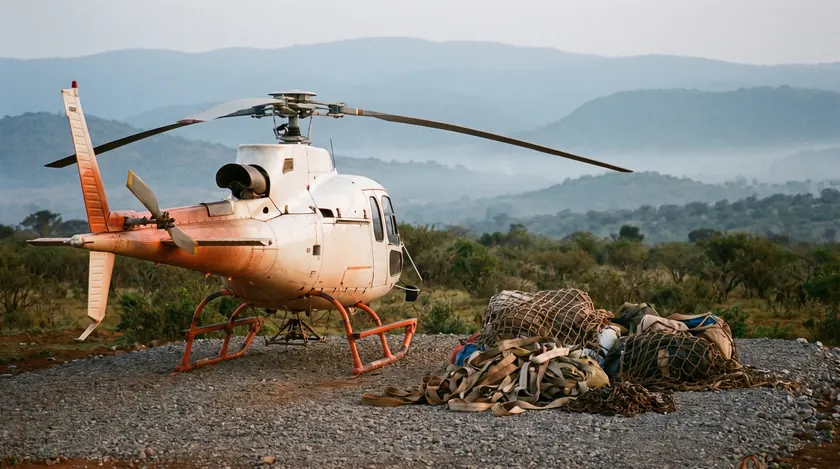
Ask a Kenyan buyer what has held the market back and duty policy comes up before aircraft condition does. Import tax on helicopters has moved back and forth between 2020 and 2023, and AvBuyer points to that uncertainty as a reason East Africa's tourism-driven market has grown more slowly than its flying does.
We start with that because it changes how you should time a purchase. The rest of this page covers what the fleet actually flies, what a 2026 budget buys, and how a purchase moves through the Kenya Civil Aviation Authority.
Kenya's shifting import duty and VAT
Import duty on aircraft and parts is nominally 0% under the East African Community Common External Tariff. The Finance Act 2020 briefly introduced a helicopter-specific import duty of 25%, then the Finance Act 2023 exempted aircraft and spares from the standard 16% VAT and scrapped the 3.5% Import Declaration Fee and 2% Railway Development Levy that used to apply to aircraft. Policy has moved in both directions inside three years, so current Kenya Revenue Authority guidance should be reconfirmed before you commit to a specific import.
Safari, tourism and government flying from Wilson Airport
Kenyan helicopter activity centres on safari and tourism flying out of Nairobi's Wilson Airport to the Maasai Mara, Amboseli and Laikipia conservancies, with operators including Tropic Air and Mombasa Air Safari. A police and government segment sits alongside it, and a smaller private-owner base rounds out the register.
Wilson Airport itself is Kenya's principal general-aviation, helicopter and safari hub, and hosts KCAA-approved maintenance organisations Phoenix Aviation, Avionicare EA and AviorTech Services. Jomo Kenyatta International in Nairobi carries the VIP and business-charter traffic, and Nanyuki Airport in Laikipia County is the gateway to Mt Kenya, the Laikipia Plateau and the private conservancies, where Tropic Air has held KCAA Approved Maintenance Organisation status for 16 years across fixed-wing and rotary types.
Helicopter price in Kenya
Six tiers span most of the Kenyan market, from a piston trainer to a VIP-capable twin, with the two Robinsons and the two Airbus singles side by side. Prices below are for pre-owned aircraft in 2026, indicative until checked against the specific airframe, its hours and its component times.
| Tier | Model | Typical use | 2026 price range (USD) |
|---|---|---|---|
| Piston entry | Robinson R44 Raven II | Private flying, training | $110,000 - $838,760 |
| Turbine step-up | Robinson R66 | Private owners moving up from the R44 | $680,000 - $1,900,000 |
| Legacy safari single | Bell 206 JetRanger/LongRanger | Safari, utility, game-count work | $310,000 - $1,800,000 |
| Wide-cabin single | Airbus H130 | Scenic flights and VIP transfers, seven seats | $1,000,000 - $2,900,000 |
| Modern safari single | Airbus H125 | Safari and conservancy flying, hot-and-high | $3,200,000 - $3,900,000 |
| Light twin | Leonardo AW109 | VIP and business charter | $2,500,000 - $6,900,000 |
Why the Bell 206 still matters here
AvBuyer ranks the Bell 206 as the second most-populous turbine helicopter type in Africa after the AW139. A large number of high-time, African-registered JetRangers and LongRangers remain in utility, tourism, training and game-capture roles, Kenya's conservancy circuit included, which keeps parts and pilot experience easier to find than for rarer types.
Where the R66 and H130 fit
The R66 is the turbine step-up for an owner who learned on an R44 and wants the same cabin with a Rolls-Royce RR300 behind it. AvBuyer notes its lower component cycle limits, which is why high-utilisation conservancy operators still put a Bell 206 or an H125 on daily work. The H130 shares the H125's dynamic components but adds a seven-seat cabin and the quieter Fenestron tail rotor, so it goes to scenic and VIP flying rather than sling work. Full specs sit on each model page.
Cost of owning a helicopter in Kenya
The purchase is the first cheque, not necessarily the biggest. Over a few years of ownership, six lines decide what a helicopter in Kenya really costs:
- Purchase: the ranges above, from about $110,000 for an older R44 to $2.5 million and more for an AW109.
- Direct operating cost: budget roughly $300 to $500 per flight hour for an R44, $450 to $650 for a Bell 206 and $700 to $900 for an H125, covering fuel and routine maintenance reserve (market estimates). Multiply by the hours you expect to fly.
- Scheduled maintenance and overhauls: inspections at a KCAA-approved AMO at Wilson or Nanyuki, plus component overhauls that often travel to South Africa, adding freight and downtime. The component times on the aircraft you buy decide when those bills arrive.
- Insurance: hull and liability premiums follow the aircraft's value, the pilot's hours on type, the mission and the base, so safari and utility work price differently from private flying. Get a quote before you commit.
- Hangarage at Wilson: space is quoted by the operators and maintenance organisations based at the airport, and availability varies, so settle it before the aircraft arrives.
- Crew and import tax: a professionally crewed aircraft adds salaries and recurrent training, and the duty and VAT position above should be reconfirmed with KRA at the time of import.
Before you make an offer, we lay these lines out for the specific airframe: the asking price, the overhauls falling due in your first years, and the running cost at your planned hours.
Want ownership numbers for one particular aircraft? Send the model, your planned hours a year and where it will be hangared.
Get options in KenyaHow to buy and import a helicopter into Kenya, step by step
Eight steps take a Kenyan buyer from a first message to an aircraft flying on 5Y- marks. The order matters: duty and registration are settled before money moves, not after the ferry flight lands.
- Brief us on WhatsApp: the mission (safari transfers, conservancy work, charter or private flying), the budget, and the base, Wilson or Nanyuki.
- Shortlist: airframes with hours flown, component times and overhaul status, logbooks shared before anyone travels.
- Records review and pre-purchase inspection: at the seller's base or at a KCAA-approved AMO, with the type-specific checks flagged in advance.
- Tax position: we confirm the current duty, VAT and levy treatment of the aircraft's HS code with the Kenya Revenue Authority before you sign, because the position has changed twice since 2020.
- Sale and escrow: purchase agreement, escrow, and a clean de-registration certificate from the previous registry, ZS-, 5N- or other.
- KCAA registration: application for the 5Y- Certificate of Registration and the airworthiness paperwork KCAA requires for the type.
- Delivery: ferry flight or shipping to Wilson or Nanyuki, customs clearance, receipts kept in the aircraft file.
- Handover: insurance in place before the first flight, and an introduction to a KCAA-approved AMO, Phoenix Aviation, Avionicare EA or AviorTech Services at Wilson, or Tropic Air at Nanyuki.
The table sums up what import currently adds, and who confirms it.
| Charge | Position | Note |
|---|---|---|
| Import duty | Nominally 0% under the EAC Common External Tariff | A 25% helicopter-specific duty appeared briefly under the Finance Act 2020 |
| VAT | Aircraft and spares exempted by the Finance Act 2023 | Standard rate otherwise 16% |
| Import Declaration Fee | Scrapped on aircraft, 2023 | Was 3.5% |
| Railway Development Levy | Scrapped on aircraft, 2023 | Was 2% |
Where the aircraft lives afterwards
Ongoing upkeep sits on our Kenya maintenance page, and our overview of Kenya's helicopter market covers operators, bases and the KCAA. Heavier components still travel to South African suppliers, so compare notes with our South Africa listings too. Choosing between piston and turbine for Laikipia and Mt Kenya altitudes, read the R44 vs R66 guide.
Buying before the dry season: a November 2026 note for Kenya
Updated 8 November 2026. The dry season runs from December to February, when Wilson Airport's safari and conservancy flying to the Maasai Mara, Amboseli and Laikipia is at its peak. A buyer who wants a helicopter flying this season has a short runway, and two of the eight steps above do not compress: the Kenya Revenue Authority check on duty, VAT and levy treatment, which has moved twice since 2020, and the pre-purchase inspection at a KCAA-approved AMO at Wilson or Nanyuki. Components that travel to South Africa for overhaul add freight time on top.
What we can do in November is run the shortlist and the records review in parallel with the tax check, so the aircraft, its component times and the KRA position land in one message. Send the mission, the budget and the base, Wilson or Nanyuki, on WhatsApp.
Common questions about buying in Kenya
What does it cost to own a helicopter in Kenya?
Purchase first: 2026 listings put an older Robinson R44 near $110,000 and an Airbus H125 at $3.2 to $3.9 million. Then add direct operating cost, estimated at $300 to $500 per flight hour on an R44 and $700 to $900 for an H125, plus insurance, hangarage at Wilson or Nanyuki, crew and overhaul reserves. Those last items depend on the aircraft, the pilot and the mission, so they are quoted per case.
Why does Kenya's helicopter import tax keep changing?
Policy has swung twice in three years: the Finance Act 2020 briefly introduced a 25% helicopter-specific import duty, and the Finance Act 2023 reversed course by exempting aircraft and spares from the standard 16% VAT and scrapping two related import levies. AvBuyer names this uncertainty as a factor that has slowed East Africa's tourism-driven helicopter market. Reconfirm current KRA guidance before you import a specific airframe.
What is the most common helicopter in Kenya's safari fleet?
The Bell 206 JetRanger and LongRanger remain widely flown, AvBuyer ranks the type as the second most-populous turbine helicopter in Africa after the Leonardo AW139, and a large high-time fleet still works Kenya's utility, tourism and game-capture roles. The Airbus H125 is the modern turbine most used for the same hot-and-high safari and conservancy flying.
Where do safari and conservancy helicopters operate from in Kenya?
Wilson Airport in Nairobi is Kenya's principal general-aviation, helicopter and safari hub. Nanyuki Airport in Laikipia County serves as the gateway to Mt Kenya, the Laikipia Plateau and the private conservancies, while Jomo Kenyatta International carries VIP and business-charter traffic into Nairobi.
Where can I get a helicopter maintained in Kenya?
Wilson Airport hosts three KCAA-approved maintenance organisations, Phoenix Aviation, Avionicare EA and AviorTech Services, and Tropic Air's Nanyuki facility has held AMO approval for 16 years across fixed-wing and rotary types. Heavier components and parts are frequently sourced through South African suppliers given the smaller local support base. See our Kenya maintenance page.
How do I buy a helicopter in Kenya and import it?
Brief, shortlist, inspection, tax check, sale, registration, delivery, handover: eight steps. The two that catch buyers out are the tax check with the Kenya Revenue Authority, since duty, VAT and levy treatment of aircraft changed in 2020 and again in 2023, and the de-registration certificate from the previous registry, which KCAA needs before it issues 5Y- marks. We run both before any deposit is paid.
Can a helicopter bought in November be flying in Kenya by the dry season?
Sometimes, if the aircraft is already in East Africa and its records are clean. An import adds the KRA tax position, de-registration from the previous registry and 5Y- marks from the KCAA, plus the ferry flight or shipping. We tell you which case yours is before you commit.
Ready to look at Kenya's market?
Tell us three things, the mission, the budget and the base, Wilson or Nanyuki, and we come back with airframes, their component times and the current KRA position on import.
Get options in Kenya