Service desk
Helicopter maintenance, parts and management in Africa
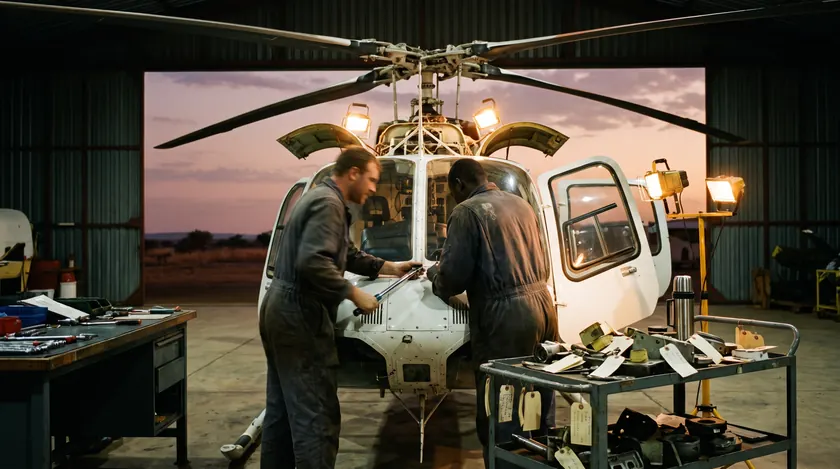
A grounded helicopter burns money in three ways at once: the check it is waiting for, the revenue it is not flying, and the crew still on payroll. The service desk exists to shorten that time on the ground, anywhere on the continent.
We are not a workshop. We are the network that knows which approved maintenance organisation actually holds the rating for your type, where the part is sitting, and which freight route clears customs this week.
What the desk arranges
| Service | What it covers | Where it happens |
|---|---|---|
| Scheduled maintenance | 100-hour, annual and calendar inspections at an AMO rated for your type | In-country where capacity exists, else the nearest rated AMO |
| Component overhaul routing | Engines, gearboxes, blades to the right overhaul shop with freight and customs handled | Regional hubs and OEM-approved facilities |
| AOG parts | Sourcing, verification of traceability paperwork, fastest compliant freight route | Across borders, door to hangar |
| Avionics and upgrades | Glass retrofits, ADS-B, mission equipment through rated shops | Mainly South Africa and regional partners |
| Management | Crewing, scheduling, hangarage, charter revenue through licensed operators | Your base country |
Prefer to just ask? Send a short message, we reply the same day.
Get a service quoteThe African maintenance reality, honestly
Capacity is uneven. South Africa has the continent's deepest rotorcraft maintenance base, and heavy work from across the region routes there or to Europe and the Gulf. Nigeria has real offshore-driven capability concentrated around the majors' contractors. Elsewhere, in-country work covers line and light scheduled maintenance, and the desk's job is honest routing: what can be signed off at home, what must travel, and what a mobile team can do on your pad.
Country detail: Nigeria, South Africa, Kenya, Ghana, Angola.
Parts without the pain
Rotorcraft parts live and die by traceability. Every component we source moves with its release certificate, and we check the paperwork before the invoice, not after: an untraceable gearbox is scrap metal at any price. Duty and VAT on parts differ by country; the country pages carry the current position and the authority to confirm it with.
For owners weighing a purchase, the same network answers the pre-buy question that matters most: what will the next 500 hours cost on this serial number? That math is half of the used turbine checklist.
Management: the machine should work when you don't fly it
A private helicopter flying 100 hours a year carries fixed costs sized for 400. Placed with a licensed operator, it can earn charter revenue between your flights, with crewing, scheduling and maintenance planning handled professionally. We structure the agreement, you keep priority access to your own machine. The running-cost math is in the operating cost guide.
Frequently asked questions
Can you handle an AOG right now?
Send the type, serial, part number if known and where the machine sits, on WhatsApp. AOG requests get worked first: sourcing, traceability check and the fastest compliant freight quote usually inside a day.
Who can legally sign off work on my registration?
An organisation approved by your registry's authority, NCAA for 5N-, SACAA for ZS-, KCAA for 5Y-, GCAA for 9G-, INAVIC for D2-, holding a rating for your type. We match machine to AMO so the release is valid, not just the work done.
Do you supply second-hand parts?
Serviceable used components with full traceability and release paperwork, yes: that is often the sensible route on legacy types like the Bell 206 or S-76. Anything without papers we will not touch.
What does management cost?
Structures vary from simple hangarage-and-crewing to full charter placement with revenue share. Quoted per case once we know the machine, base and how much you fly. The conversation costs nothing.
Grounded machine or due check?
Type, serial, where it sits, what it needs. The desk replies with a plan the same day.
Get a service quote