Bell's six-passenger turbine single
Bell 407GXi for Sale in South Africa
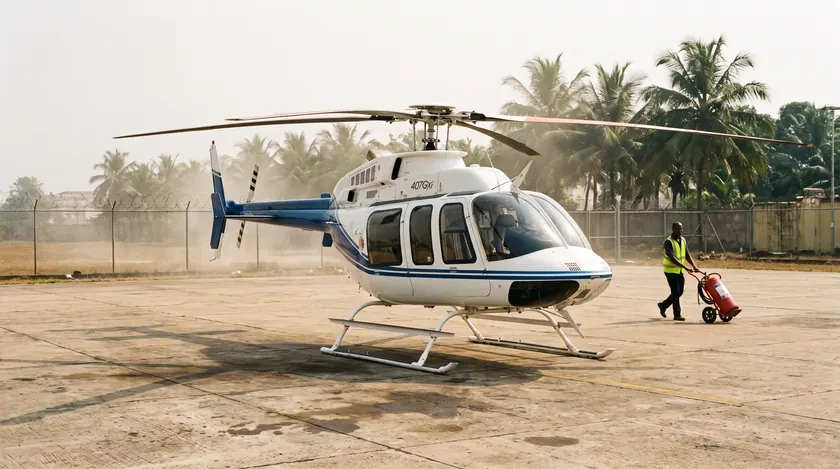
| Spec | Detail |
|---|---|
| Passengers | Up to 6 |
| Range | 337 nm |
| Cruise speed | 133 kts |
| Cabin | 1 pilot + up to 6 passengers; Garmin G1000H NXi glass-cockpit avionics |
| Produced | Bell 407 family since 1996; 407GXi variant since 2018, currently in production |
Ask an African operator to name the two light singles that dominate the market and you will hear the H125 and the Bell 407GXi in the same breath. AvBuyer names them as Africa's two market-leading light-single turbines, and the 407GXi earns its half of that reputation with a Garmin G1000H NXi glass cockpit and a lineage that goes back to the original Bell 407 in 1996.
The 407GXi is the current, in-production version of that airframe, built since 2018. Buyers usually already own or have flown an earlier 407GX or GXP and are upgrading, or are cross-shopping it directly against the H125 for a utility, tourism or EMS role.
Both types are sold and supported through established dealer networks on the continent, so parts access is rarely the deciding factor between them. The decision usually comes down to budget and which type your chief pilot already knows well.
Bell 407GXi price in 2026
Pre-owned 407GXi airframes run roughly $3.0 million to $4.3 million as of 2026 for low-time, recent-build examples. Step down a generation to the older 407GX or GXP and the range drops to about $2.2 million to $3.0 million, and a legacy late-1990s or 2000s Bell 407 typically trades for $1.3 million to $2.0 million.
That three-tier spread means the generation of avionics and engine variant matters as much as raw airframe year. Two aircraft built a few years apart can sit in different price tiers entirely if one has the current G1000H NXi glass cockpit and the other an older suite, so confirm exactly which 407 generation you are quoted before comparing numbers across listings. A seller advertising a 407GXi at a GX-era price, or the reverse, is a signal to ask more questions before you fly out to inspect it. Confirm the serial number and production year against Bell's own records rather than relying on the model name alone.
Engine and airframe checks on a Bell 407GXi
The 407GXi's inspection list centres on the rotor system, the Rolls-Royce engine and the glass cockpit, plus the usual corrosion check for an airframe that may have worked a coastal or offshore-adjacent base.
- Track the composite main rotor blade and yoke against their life limits.
- Borescope the Rolls-Royce M250-C47E/8 engine and review its hot-section overhaul history.
- Check the tail-rotor drive-shaft and hanger-bearing condition.
- Pull the Garmin G1000H NXi avionics fault and service history.
- Inspect the tailboom and skid gear for corrosion, common on aircraft based on the coast or near offshore operations.
- Check skid-tube wear if the aircraft has been used for training or high-cycle utility flying.
- Confirm the full compliance record against every mandatory Bell Service Bulletin and Directive issued since the aircraft was imported.
Comparing 407 generations? Send the serial numbers and we sort GX, GXP and GXi for you.
Ask about Bell 407GXiSafari and VIP configurations
A 407 sold into lodge and safari work and one sold into VIP transport can be the same airframe with a different cabin, and the fit changes both price and running cost. Safari and utility buyers tend to look for air conditioning, cargo-hook provision and tough, easily cleaned seating; VIP buyers look for a quieter, better-trimmed cabin with air conditioning, and EMS operators for a stretcher-capable interior that converts back to passenger seats.
Whichever fit you are offered, ask three questions: which optional kit is actually installed, is each item covered by approved installation paperwork, and is its weight in the current weight and balance report. Kit that is fitted but not properly documented costs money to regularise before it can fly under ZS- marks.
Older airframes matter here too. Many 407s on the South African market are GX, GXP or legacy late-1990s and 2000s builds rather than GXi, and their cabins and avionics reflect that; the price section above splits the three tiers.
Bell 407 in South Africa
Support is the first reason the 407 does well locally. NAC at Rand Airport holds Bell factory authorisation for full maintenance and overhaul, and represents Bell sales in six African countries, so engine and dynamic-component work on the Rolls-Royce M250-C47E/8 does not have to leave the country. Private and corporate 407s base at Rand, Grand Central and Lanseria around Johannesburg, while others work from Nelspruit for Lowveld lodges and from coastal bases at Cape Town and Durban.
The missions are utility, tourism, EMS and VIP transport. Import VAT on a 407 brought in from abroad is 15% of the customs value, reclaimable as input tax when a VAT-registered operator uses it for taxable supplies, and SARS sets any duty by the HS Chapter 88 subheading. On the Highveld, with Johannesburg's airfields at 4,100 to 5,500 ft, check the hover and payload charts at summer temperatures before you promise a lodge six seats and full tanks. Photos and full spec sheets of specific 407GXi airframes are available on request via WhatsApp, with the exact cabin fit listed.
Who the Bell 407GXi suits in Africa
The 407GXi does the same job the H125 does across much of Southern Africa: utility flying, tourism, EMS and oil-and-gas crew-change support, often for operators who already run Bell types and want commonality with the rest of the fleet. It is a straight cross-shop against the Airbus H125, and the choice usually comes down to existing fleet type, parts relationships and pilot preference rather than a large capability gap. EMS operators in particular favour the type for its cabin reconfiguration options between a stretcher fit and a standard passenger layout, useful for operators running mixed contracts rather than one fixed mission.
Operators replacing an older Bell 206 often land on either the 407GXi or the smaller Bell 505, depending on whether they need the extra seat and payload.
Bell 407GXi operating costs
Estimates put the 407GXi at roughly $550 to $900 an hour, depending on utilization and which industry source you check. That band is wide because utilization and maintenance-program enrollment move the real number so much on this type: an operator flying regularly on a structured programme lands nearer the bottom than one flying irregularly with reactive maintenance. Use the figure to size a budget, then test it against the specific airframe's maintenance history and a quote from an approved maintenance organisation before committing.
Ready to talk about a Bell 407GXi?
Tell us the mission, the cabin fit you need and the budget, and we come back with airframes that match rather than a long list.
Ask about Bell 407GXi