Working rotorcraft, not executive transport
A Helicopter for the Farm or Game Reserve
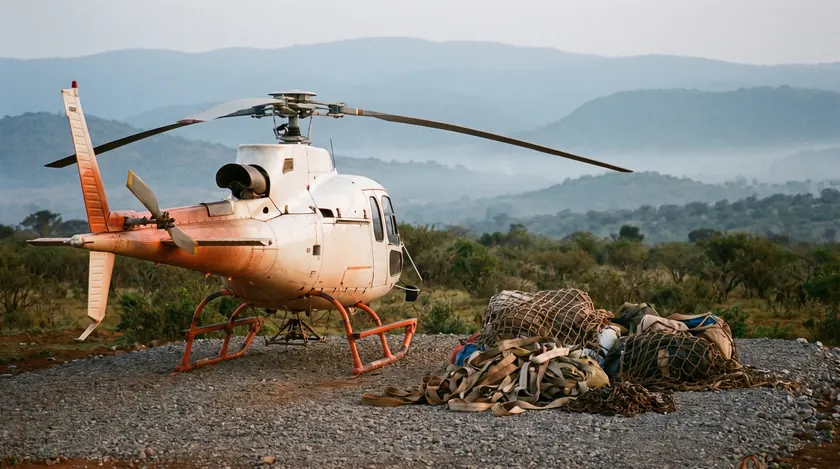
Most helicopter marketing shows a machine landing at a hotel. Most helicopters in rural southern Africa do nothing of the sort: they count game at first light, push cattle between camps, carry a vet with a dart gun, patrol a boundary fence at night, or spray a crop line a fixed-wing cannot safely follow. This is the working end of the market, and it is the end this desk knows well.
This guide is for the owner of land rather than the owner of a schedule: which machines earn their keep on a game farm or ranch, what anti-poaching flying really involves, whether mustering and spraying justify owning rather than hiring, and what it takes to keep a helicopter serviceable at the end of a gravel road.
Why game farms in South Africa run their own helicopters
Scale is the short answer. A game property measured in thousands of hectares cannot be managed from a bakkie: a waterhole check that takes a morning by road takes minutes from the air, and some jobs cannot be done any other way at all. The working list on a typical reserve includes annual game counts, which auditors and buyers increasingly expect to be flown; game capture and relocation, where the helicopter positions animals toward bomas and carries the darting vet; veterinary darting for treatment and collaring; fence and boundary patrol; fire spotting and, in the worst weeks, fire direction; and guest work where tourism is part of the business.
The ownership question is utilisation. An operation that hires a capture crew two weeks a year should keep hiring. A property flying weekly, or a group of neighbouring farms sharing a machine and a pilot, starts to justify a hull of its own, and the arithmetic for that decision is the same hours-based logic we apply across the helicopters we sell.
Which helicopter for a game farm: R44, R66 or H125?
Three machines cover most of this market, and the honest ladder runs like this.
The Robinson R44 is the entry point and the most common private machine on African farms for a reason: four seats, piston simplicity, and acquisition and running costs no other serious helicopter approaches. Its limits are payload and hot-and-high margin, which on a highveld summer afternoon are not theoretical. The Robinson R66 answers both with a turbine: better altitude performance, five seats, jet fuel instead of avgas, at a meaningfully higher purchase price. Our R44 vs R66 comparison runs that choice in full.
The Airbus H125 is the professional tool: the machine serious capture operators, survey firms and parks services reach for, with the power, sling capability and parts ecosystem to work hard at altitude for decades. It costs several times a Robinson to buy and run, and for a commercial game-work operation it is usually worth every cent. Buy the mission, not the badge: a farm that mostly checks fences does not need capture-grade power.
Know the property and the jobs but not the machine? Describe the land, the altitude and the work, and we will shortlist honestly, including the option of not buying.
Discuss a farm machine on WhatsAppWhat does an anti-poaching helicopter operation involve?
More than a helicopter, and any seller who implies otherwise is doing the reserve a disservice. Aerial support has proven its value in rhino and elephant protection, but it works as one layer in a system: ground teams, intelligence, dog units and response planning, with the aircraft multiplying the reach of all of them. A machine on its own deters casually and catches rarely.
The flying itself is demanding. Response work happens at short notice, often at dawn, dusk or night; night operations need approved equipment, current pilots and, where thermal or stabilised cameras are fitted, an installation done through the proper certification channels rather than a bracket and hope. Insurance must reflect the mission honestly. Some reserves run their own machine for daily presence and contract specialist operators for night and pursuit work, which is often the most defensible structure both legally and financially.
We supply aircraft into conservation work and can introduce the operators and equipment houses who do the mission packaging properly. What we will not do is sell a standard machine as an anti-poaching system. The gap between those two things is where programmes fail.
Cattle mustering by helicopter: does it pay in Africa?
Helicopter mustering built its reputation on Australian stations, and the same logic transfers to large African cattle operations: a helicopter moves stock faster and with less stress than days of riders across big country, finds strays that ground teams miss, and doubles as the property's general aerial workhorse between musters. The R44 earned much of its global reputation doing exactly this work.
The caveats deserve equal billing. Mustering is genuine low-level flying, among the more demanding civilian missions there are, and it is pilot skill, not machine capability, that keeps it safe: this is work for specifically experienced pilots, flown within the rules that govern aerial work, never for a newly licensed owner teaching himself over his own herd. Insurers price that risk accordingly and will want the mission declared. For many ranches, the honest answer is a hybrid: contract an experienced mustering pilot for the big seasonal moves, and use the farm's own machine, if it has one, for the daily checking that needs no heroics. Where herd scale and distances are large enough, owning outright starts to pay.
What does a crop spraying helicopter cost in Africa?
Helicopter spraying earns its place where fixed-wing agricultural aircraft struggle: small or irregular fields, steep ground, orchards and vineyards, and crops where the rotor's downwash drives product into the canopy instead of past it. In southern Africa that means high-value horticulture more often than broadacre grain, which fixed-wing operators serve more cheaply per hectare.
On cost, honesty requires ranges rather than a number. A spray operation is a machine plus an approved spray system plus the certification to use it: piston machines like the R44 fly a large share of the world's helicopter spraying, with turbines above them for payload, and the all-in cost of a used, equipped piston spray machine typically lands in the low-to-middle hundreds of thousands of dollars, with turbine setups well beyond that. Current market bands by model sit in our price guide. The sharper question is commercial: spraying for hire is a certified aerial-work business with seasonal revenue, and a farm spraying only its own land rarely flies enough hectares to beat simply contracting a licensed operator. We run that calculation with buyers before they commit.
Owning on the farm: strip, fuel, dust and maintenance
A helicopter based on a farm lives a different life from one in a city hangar, and the ownership plan should respect it.
Shelter first: sun and dust age an airframe parked outside at speed, so a basic enclosed hangar is not optional on a working property. Fuel is logistics rather than infrastructure: avgas for a piston machine or jet fuel for a turbine, stored and filtered properly, with quality control treated seriously because contaminated farm fuel ends careers. Dust itself is the quiet enemy, which is one reason turbines with inlet protection suit bush strips, and why wash-downs and filter discipline matter more here than anywhere.
Maintenance reach decides serviceability: scheduled inspections do not care how far the farm is from the nearest approved facility, so build the relationship before the machine arrives, through a shop like those on our maintenance pages, and plan the ferry flights into the budget. And buy with the paper trail in front: a used machine for farm work gets the same component-time and records scrutiny as any purchase, per our used turbine checklist. Remote basing forgives nothing bought carelessly.
Frequently asked questions
Can you dart game from a Robinson R44?
Darting and capture work is flown from R44s as well as turbines, but the question is less the machine than the operation: game capture is specialised aerial work with its own approvals, experienced capture pilots and vet teams, and hot-and-high conditions that shrink a piston machine's margins. Many professional capture outfits fly turbines for exactly that reason. If capture is a core mission rather than an occasional need, specify the machine for it from the start.
Do I need a commercial licence to fly a helicopter on my own farm?
Flying yourself over your own land for private purposes is one thing; aerial work such as spraying, game capture or flying for hire sits under operator certification and its own rules, even on private land, and the line between the two is drawn by regulation rather than by fence lines. Confirm your specific missions with the South African Civil Aviation Authority or an aviation lawyer before structuring the operation, and declare every mission honestly to your insurer.
Is a turbine worth the extra cost for bush and high-altitude work?
Above roughly the highveld's density altitudes, and on hot days with real loads, the turbine's performance margin stops being a luxury: it is the difference between a machine that does the job in the conditions you actually face and one that does it only on cool mornings. Operations at the coast with light loads live happily on pistons. Our R44 vs R66 guide puts numbers on that line.
What does it cost per hour to run a helicopter on a farm?
It varies by type too much for one honest figure: fuel burn, scheduled maintenance reserves, insurance and the component-overhaul clock all scale with the machine. Our operating cost guide for the region breaks the hourly maths down type by type, and for any specific aircraft on our books we provide the full cost picture, including the farm-basing extras this page describes, before you offer on it.
Tell us about the property and the work
Hectares, altitude, the jobs list and whether a pilot already exists: that is enough for a first honest recommendation, machine and budget included.
Discuss a farm machine on WhatsApp