Model comparison
R44 or R66: picking the right Robinson for African conditions
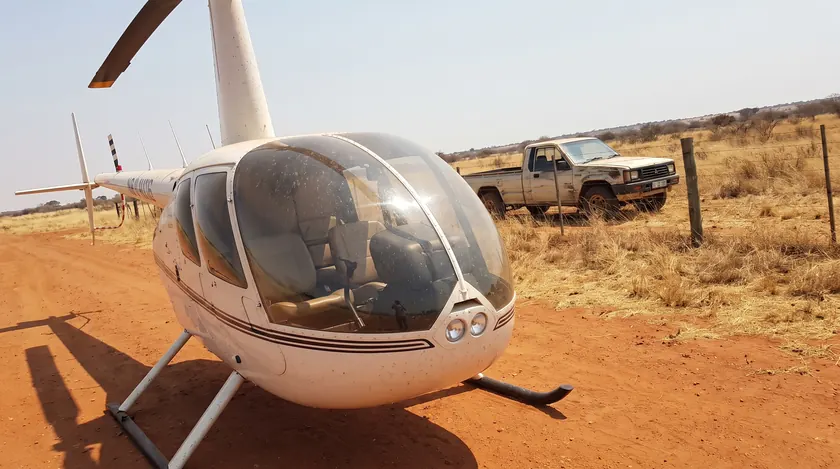
This is the comparison we get asked to settle more than any other. Both helicopters are common across Africa's private-owner, training and light-utility fleets, both come from the same factory, and both get shortlisted by the same buyer at some point in the search. They are not interchangeable once you look past the shared cockpit layout.
Below is the honest version: what each one costs to buy and fly, what the overhaul clock actually looks like, how they behave at altitude, and how each resells once you are ready to move on. Then a straight recommendation by mission, because that is the question that actually matters.
What is the difference between the Robinson R44 and R66
The R44 Raven II runs a Lycoming IO-540 piston engine. The R66 is the turbine step-up, built around a Rolls-Royce RR300. That single difference cascades through everything else in the table below: purchase price, fuel type, hot-and-high performance and how the overhaul clock behaves.
| Factor | Robinson R44 Raven II | Robinson R66 |
|---|---|---|
| Engine | Lycoming IO-540 piston | Rolls-Royce RR300 turbine |
| Pre-owned price, 2026 range | $110,000-$838,760 | $680,000-$1.9M, average approx. $1.24M |
| New list price | approx. $646,000 (2027 model) | $1.456M-$1.9M fully equipped (2025-2027 models) |
| Hourly direct operating cost | $300-500/hr, cited | $450-600/hr, estimate |
| Overhaul reality | Mandatory 2,200-hour/12-year rotor and mast overhaul | Same Robinson mandatory life-limit regime, plus RR300 TBO tracking and lower cycle limits on some components |
| Resale in Africa | Deepest pool on the continent, 300+ units, mostly South Africa | Smaller but growing; cycle limits have capped uptake in high-utilization utility roles |
Is the R66 more reliable than the R44
Reliable is the wrong word for what actually changes. A turbine has fewer reciprocating parts than a piston engine, delivers power more smoothly, and does not need mixture management, so day to day it feels like the simpler machine to fly and to maintain in the sense that matters to a pilot. What it trades for that is a shorter list of cheap fixes: an RR300 hot-section or overhaul event costs more than anything a Lycoming will ask of you, and both engines still sit underneath the same Robinson rule that governs the two types equally, the mandatory main rotor blade and mast overhaul on a fixed hours and calendar clock.
Both types carry the same buyer's-checklist item worth taking seriously: confirm there is no history of mast-bumping in the logbooks. It is a Robinson-specific risk on both the R44 and the R66, not a piston-versus-turbine question, and it is a bigger factor in resale value than which engine is under the cowling.
How much does an R66 cost compared to an R44
At the low end, a high-time R44 Raven II can trade for around $110,000, against an R66 floor closer to $680,000. At the top of each range, a late-model R44 tops out near $838,760 while an R66 can run to $1.9 million. New, Robinson lists a 2027-model R44 around $646,000 against $1.456-1.9 million for a fully equipped current R66. Inside South Africa specifically, NAC's helicopter-sales division has listed a Raven II locally at roughly $215,415 (R3,500,000 excluding VAT), which is worth knowing if you are shopping the South African market rather than the wider Controller.com-listed pool.
The gap is not just sticker price. An R66 buyer is also paying for the fuel-burn and maintenance profile of a turbine, so the true multi-year cost gap is wider than the acquisition numbers alone suggest.
Altitude performance: where the turbine earns its price
Which Robinson is best for high-altitude flying
The R66's turbine holds its power far better than the R44's piston as density altitude climbs, which is the practical reason conservancy and game-capture operators working the Laikipia Plateau around Nanyuki, or any elevated African airstrip, tend to spec the R66 over the R44 once budget allows it.
Can the R44 operate well in hot-and-high African conditions
It can, within limits, and a great many R44s do exactly this kind of work across Southern and East Africa every day. The margin is thinner than on a turbine, so a hot afternoon at a high-elevation strip eats into useful load faster on the piston airframe. Neither Robinson publishes a hot-and-high performance chart as detailed as Airbus provides for the H125, so if your operation sits above roughly 6,000 feet density altitude on a routine basis, get the specific performance figures for your exact aircraft and load from a Robinson dealer before you commit, rather than trust reputation alone.
Prefer to just ask? Send a short message, we reply the same day.
Ask a questionWhat is the operating-cost difference between the R44 and R66
Direct operating cost runs $300-500 an hour on the R44 against an estimated $450-600 an hour on the R66, so the turbine costs roughly a third to half more per hour to fly before any overhaul event lands. Both airframes answer to the same Robinson mandatory rotor and mast overhaul on a hours-and-calendar clock, so that part of the multi-year cost is comparable. Where the R66 pulls further ahead in cost is the RR300 itself: track its hours against Rolls-Royce's published TBO and treat that overhaul as a separate, larger line item the R44's Lycoming does not carry in the same form.
We walk through how this compares against turbine twins and the wider African cost picture in our helicopter operating-cost guide, which is useful even outside Nigeria for the method, not just the Nigerian numbers.
Recommendation logic by mission
Match the airframe to what you actually fly, not to which one feels more serious to own.
- Training and low-hour private flying at modest elevation: the R44 Raven II. Lowest entry price, cheapest hourly cost, and by far the deepest parts and resale pool in Africa, concentrated in South Africa's private-owner and training fleets.
- Conservancy, game-capture or any routine hot-and-high work: the R66. The turbine's altitude margin is the reason it exists, and it is worth the premium the moment density altitude becomes a daily constraint rather than an occasional one.
- Heavy-cycle utility or charter work: think past the Robinson pair entirely. AvBuyer specifically flags the R66's lower component cycle limits as a cap on high-utilization utility roles compared with the R44, and a heavier-duty single like the Bell 505 may suit that mission better than either Robinson.
- Budget-constrained buyer who wants to resell easily inside South Africa: the R44, on liquidity alone. It is the aircraft everyone's mechanic already knows and everyone's buyer already wants.
Whichever way the mission points, run the pre-purchase checklist before you sign anything. Our used-turbine checklist covers the R66 directly; for the R44 the same logbook and mast-bumping discipline applies, engine section aside.
Frequently asked questions
What is the difference between the Robinson R44 and R66?
The R44 Raven II uses a Lycoming IO-540 piston engine; the R66 uses a Rolls-Royce RR300 turbine. That drives a lower purchase price and hourly cost for the R44, and better altitude performance and smoother power delivery for the R66, which costs $680,000-$1.9M pre-owned against the R44's $110,000-$838,760 range.
Is the R66 more reliable than the R44?
It is a different risk profile rather than simply more reliable. The turbine has fewer moving parts and no mixture management, but both types share the same Robinson-mandated rotor and mast overhaul life limits, and both carry mast-bumping as the key logbook item to check before buying either one.
How much does an R66 cost compared to an R44?
Pre-owned R66s run roughly $680,000 to $1.9 million, averaging about $1.24 million, against $110,000 to $838,760 for the R44. New, a 2027-model R44 lists around $646,000 versus $1.456-1.9 million for a fully equipped current R66.
Which Robinson helicopter is best for high-altitude flying?
The R66. Its turbine holds power better than the R44's piston engine as density altitude rises, which is why conservancy and game-capture operators working elevated African terrain generally prefer it once budget allows.
What is the operating-cost difference between the R44 and R66?
The R44 runs $300-500 an hour direct operating cost against an estimated $450-600 an hour for the R66, roughly a third to half more for the turbine. The R66 also carries a separate Rolls-Royce RR300 overhaul event that the R44's Lycoming engine does not mirror in the same form.
Not sure which Robinson fits your mission
Tell us your typical elevation, load and annual hours and we will give you a straight answer, not a sales pitch.
Ask a question